posted
On Friday, July 10, 2026
in
Blog
Stress relieving and tempering are services offered at all four AHT locations. We find that the two heat treatments are often confused or used interchangeably when they are actually two distinct heat treatments. Because choosing the wrong process can limit nitriding temperature, case quality, or dimensional stability, this article aims to clarify:
- Key differences between the processes
- When stress relieving is required
- How each affects nitriding temperatures and performance
What Is Stress Relieving?
Stress relieving is a relatively low-temperature heat treatment used to reduce residual stresses in metal parts caused by machining, cold work, forming, straightening, or welding. The process allows the metal’s internal structure to relax, which improves dimensional stability and reduces the risk of distortion or cracking. Because stress relieving does not significantly change the material’s hardness or microstructure, it helps maintain the part’s intended mechanical properties.
What Is Tempering?
Tempering is a heat treatment performed after hardening to reduce brittleness while adjusting hardness and mechanical properties. Unlike stress relieving, tempering directly impacts the material’s microstructure and final properties.
While stress relieving is used to manage internal stresses, tempering is used as a follow-on heat treatment to manage hardness, strength, and overall performance.
Why Stress and Temper Condition Matter Before Nitriding
Nitriding diffuses nitrogen into the surface of a metal, resulting in:
- Increased surface hardness
- Improved wear resistance
- Improved fatigue strength
- Enhanced corrosion resistance
- Longer service life
- Minimal distortion
The maximum allowable nitriding temperature is determined by the steel’s final tempering temperature.
Several key factors determine the maximum nitriding temperature, including nitride case stability, retention of core hardness, and dimensional control. Because nitriding is performed at relatively low temperatures, the process is often selected when maintaining part dimensions and core properties is critical. Proper stress relieving prior to nitriding can further improve dimensional stability by reducing residual stresses that may otherwise contribute to part movement, distortion, or cracking during processing.
Stress Relieving Before Nitriding: When Is It Required?
Stress relieving before nitriding is typically required when:
- Parts have undergone extensive machining, cold forming, straightening, welding, or brazing
- Tight dimensional tolerances must be maintained
- Part distortion during nitriding is a concern
Residual stress can cause movement or distortion during nitriding even at low temperatures. Stress relief reduces risk without sacrificing hardness because it occurs at a temperature below that of the material’s transformation temperature or of the previous tempering temperature. As an example, a heavily machined tool steel component may benefit from stress relief prior to nitriding to minimize movement or distortion during the nitriding process.
Tempering Before Nitriding: Why Can’t Nitriding Exceed the Tempering Temperature?
After through-hardening (austenitize → quench), steel is left in a martensitic condition that is very hard but also brittle and highly stressed. Tempering is the follow-on heat treatment that relieves quench stresses and metallurgically stabilizes and balances the steel as brittle martensite is converted into tempered martensite, establishing a controlled balance of hardness, strength, and toughness. Nitriding must be performed at a temperature below the steel’s final tempering temperature to avoid softening or altering the core mechanical properties.
A very common rule of thumb in heat treatment (and sometimes a requirement) is: The nitriding temperature should be at least 50°F below the final tempering temperature. This margin ensures: 1.) No over-tempering of the steel, 2.) Retention of core hardness and strength, and 3.) Dimensional stability during nitriding.
The consequences of nitriding above tempering temperature are:
- Over-tempering
- Loss of core hardness
- Reduced fatigue performance
It is crucial that engineers communicate tempering history to the heat treater.
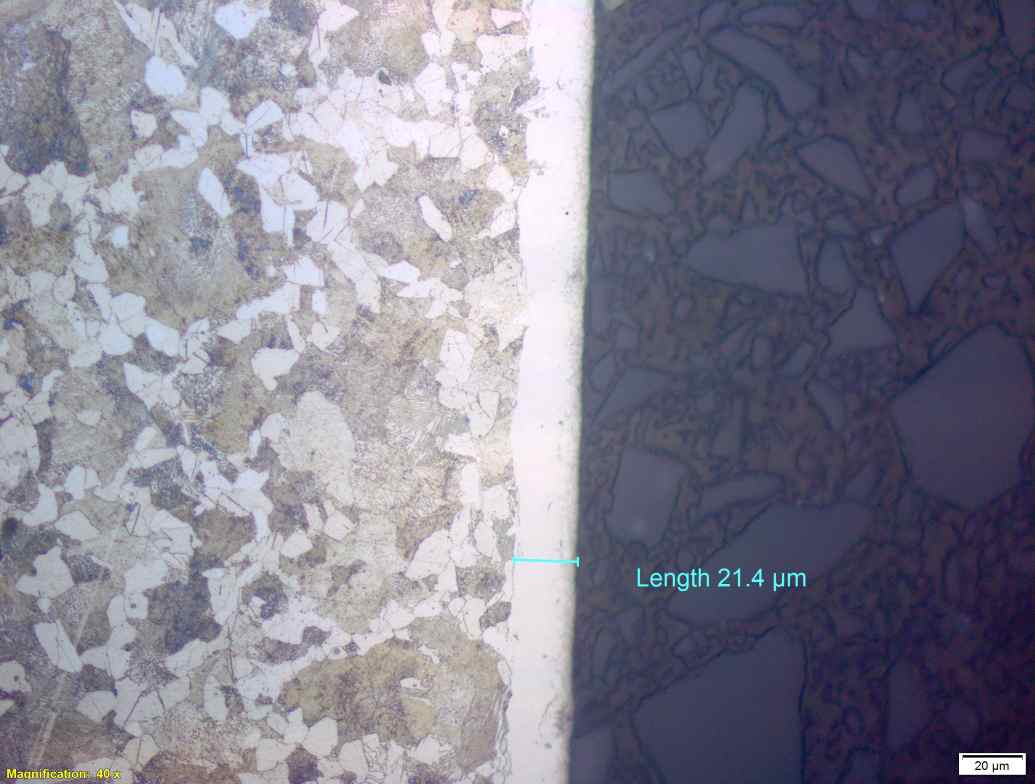 Nitrided 1045 Steel Nitrided 1045 Steel
The microstructure is pearlite/ferrite (non-hardened). This part would not be tempered, but if machining stresses were introduced and tight dimensional control is required, stress relief before final machining and prior to nitriding would be suggested.
|
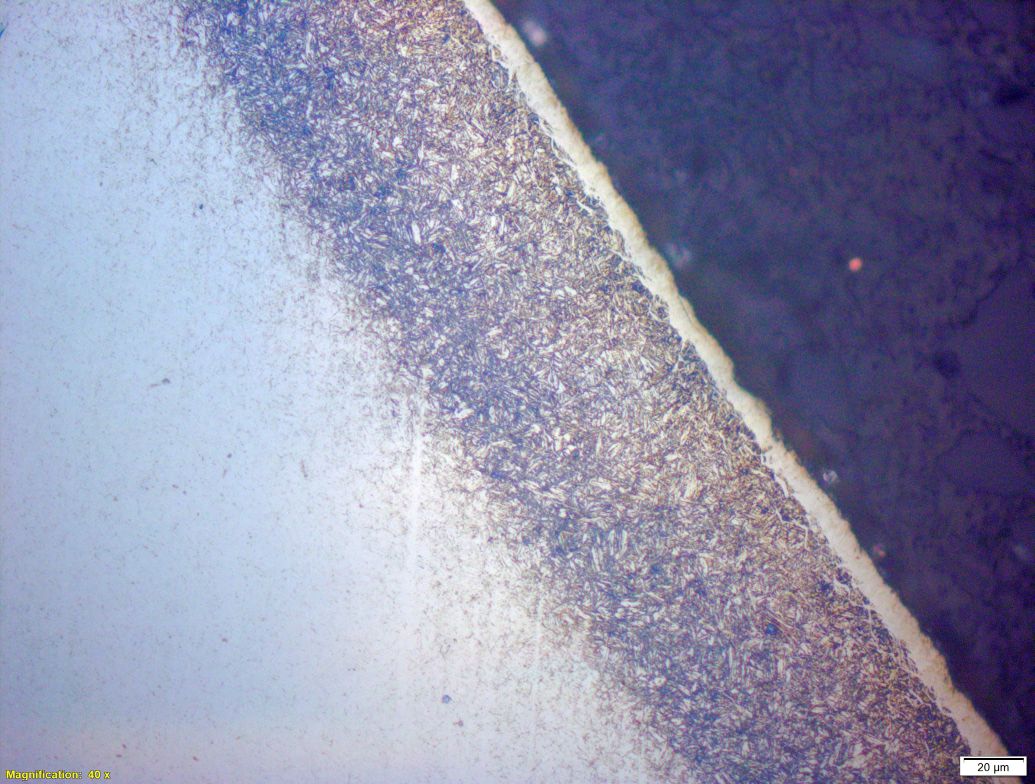 Nitrided H13 Steel Nitrided H13 Steel
The microstructure is tempered martensite (hardened and tempered at least 50F above nitriding temperature, to the desired hardness ~50 HRC).
|
Stress Relieved, but Not Tempered: Common Misconceptions Addressed
Stress relieving alone does not establish a part’s final mechanical properties. A stress-relieved part may still require proper hardening and tempering to achieve the desired hardness, strength, and performance characteristics. It is also important to note that stress relief does not “reset” nitriding temperature limits, which are still governed by the material, prior heat treatment, and required final properties.
Practical Selection Guidelines:
- If hardness requirements are critical → tempering history governs nitriding
- If distortion risk is the primary concern → stress relieving may be necessary
- If both apply → coordinate sequence carefully
Communication is key between design, manufacturing and the heat treater as incorrect assumptions upfront often show up as nitriding limitations later.
Getting Nitriding Right Starts Earlier Than You Think. Contact AHT to Discuss Your Project.
QUESTIONS? CONTACT AN AHT REP.
Key Takeaways:
- Stress relieving and tempering serve different purposes → Stress relieving reduces the risk of movement or distortion; tempering reduces brittleness while achieving the desired balance of hardness, strength and toughness.
- Both influence nitriding outcomes in different ways → Tempering impacts nitriding because it sets the temperature limit; stress relieving improves dimensional stability.
- Confirm and communicate prior to nitriding: material condition, tempering temperature and stress history.
- stress relieve
- tempering